What Spectrum is
One player sees a hidden target on a spectrum and gives a single clue. Their team spins the dial to find it.
The clue is the craft. Numbers and pointing are banned, so you name a thing that lives at that spot: with the target sitting just shy of the cold end of Cold–Hot, “yesterday’s coffee” places itself far better than any adjective could.
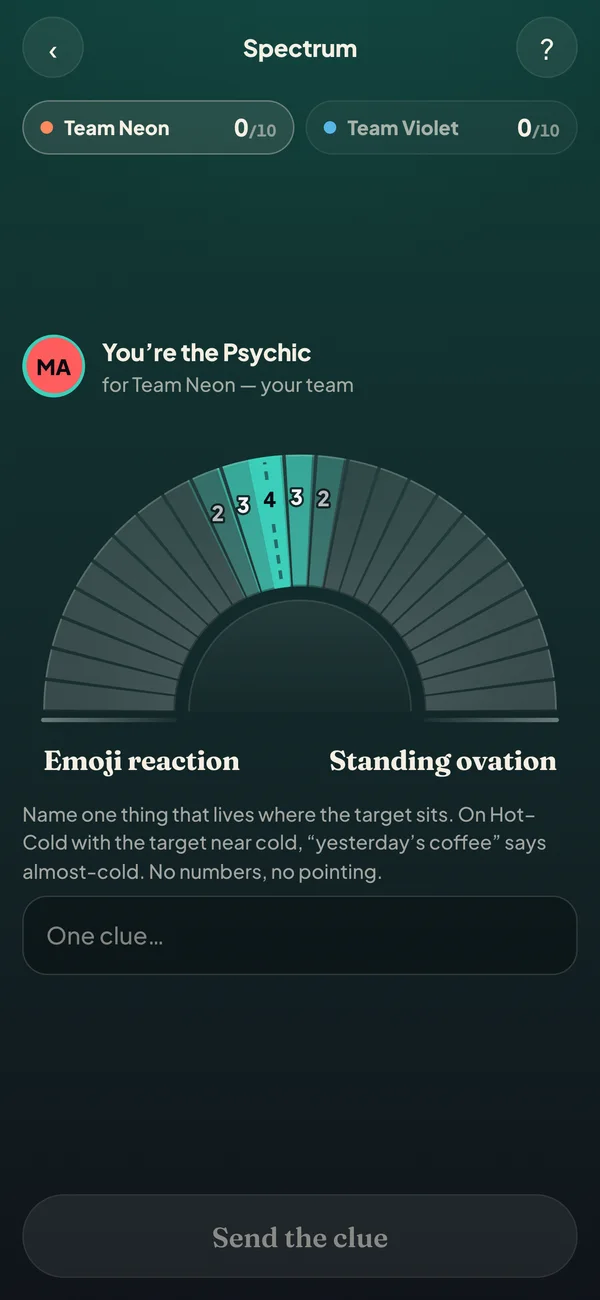
The target is five equal slices scoring 2-3-4-3-2 outward from the centre, so a near miss still pays. Meanwhile the other team is listening for which way you will lean — calling the correct side steals them a point, unless the dial lands dead on the target and leaves no side to call.
Below four players there is no second team left to steal anything, so the deal resolves to co-op instead. One shared dial, one shared score, six rounds, and the Psychic hat moving round the table.
A look at a turn
From our tables
300+ games finished
Games of Spectrum, played to the end on Table Party between 16 August and 24 September 2026.
12 minutes on average
How long a finished game of Spectrum really takes here, from the first move to the final score.
How to play Spectrum
- The Psychic secretly sees where the target sits on the spectrum.
- They give one short clue — no numbers, no pointing.
- The clue is a THING that lives at that spot. Say the spectrum is Hot–Cold and the target sits near the cold end: “yesterday’s coffee” is a great clue. Not freezing, definitely not hot — almost-cold. That’s the game.
- Their team argues about where the clue belongs, then locks in the dial.
- Closer is better: 4, 3 or 2 points. The other team can steal a point by calling which side the target was on.
How to win at Spectrum
Name a thing, not a degree
“Yesterday’s coffee” puts itself somewhere on the dial; “fairly cold” just repeats the axis back at your team.
Chase the 3, not the 4
The bullseye is four units wide out of a hundred, so most good rounds are a confident 3 rather than a lucky 4.
Agree before anyone locks
The dial is live on every phone and the first guesser to lock it in locks it for the whole team.
Guess the lean, not the target
As the opposing team you only have to call left or right, so ask which way the clue would have pulled them.
Co-op is a score to beat
With two or three of you every point goes into one table total, which is the number to come back and beat next time.
Questions about Spectrum
What makes a good Spectrum clue?
Something that occupies the spot rather than describing it. On Cold–Hot with the target near the cold end, “yesterday’s coffee” beats “quite cold”, because the room can picture it and then place it.
How are the points worked out?
The target is five equal slices scoring 2, 3, 4, 3, 2 from the centre outward, and anything past them scores nothing. The team that did not guess can add a point by calling which side the target was on.
What changes with two or three players?
The game becomes a co-op automatically. One team, one shared score, no side calls, and six rounds with the Psychic role passing round.
Can the Psychic touch the dial?
No. They give one clue and then sit out the guess — the target only ever reaches their phone, so their team locks it in without them.
Is Spectrum the box game?
No. Spectrum is Table Party’s own clue-on-a-scale game, inspired by Wavelength and independent of it. The format is explained here so you can decide whether it fits your group.
Is Spectrum free?
Yes. Every game on Table Party is free, with no accounts, no adverts and nothing to buy.
How many people do you need for Spectrum?
Between 2 and 12. Below 2 there are not enough of you for the game to work. Table Party for Teams seats up to 100 in one room.
Do we need to download anything?
No. One person opens the site and starts a room; everybody else joins by typing the room code on their own phone. Nothing to install, nothing to sign up for.
Can we play Spectrum over a video call?
Yes. Share the room code in the chat and play with the call running — everything private stays on each player’s own phone.